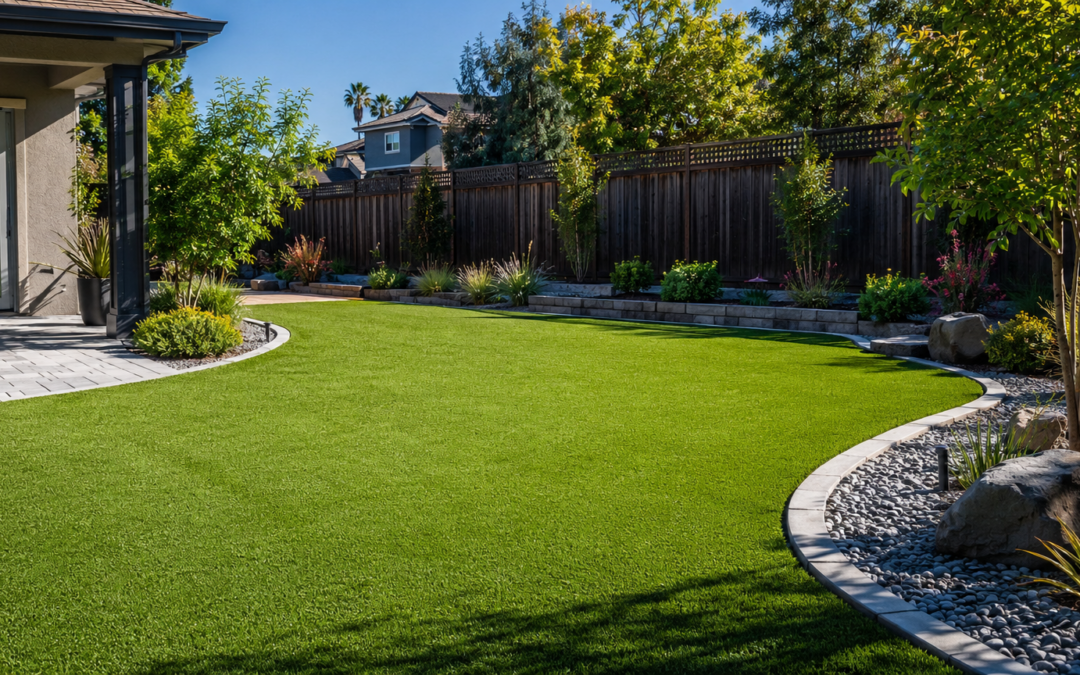
The important thing to remember is that artificial turf pricing is not simply the cost of a roll of grass multiplied by your square footage. A properly completed backyard project is a complete landscaping system. The condition of your existing yard, the type of Artificial Grass you choose, and how complicated the installation will be can all influence the final investment.
Here is how to estimate your backyard turf project and understand what is actually included in the price.
Start With Your Backyard Square Footage
The first number you need is the approximate square footage of the area you want to cover.
For a simple rectangular lawn, use:
Length × Width = Square Footage
For example:
30 feet × 20 feet = 600 square feet
If your backyard has an irregular shape, divide the lawn into several smaller rectangles or squares. Calculate each section separately, then add the totals together.
For example:
Main lawn: 25 × 20 = 500 square feet
Side section: 10 × 8 = 80 square feet
Small corner: 5 × 6 = 30 square feet
Estimated total turf area: 610 square feet
Do not worry if your measurement is not exact. At this stage, the goal is to create a useful planning estimate. A professional installer can take precise measurements and account for turf direction, seams, trimming, curves, and material waste during an on-site consultation.
Artificial Turf Cost Calculator Formula
A basic estimating formula looks like this:
Total Project Cost = Turf Area × Estimated Installed Cost Per Square Foot + Special Features or Site Costs
Rather than relying on a single online price-per-square-foot number, homeowners should consider several categories that contribute to an installed project.
Your estimate should account for:
- Artificial turf material
- Removal of existing lawn or landscaping
- Excavation and site preparation
- Base materials
- Drainage preparation
- Labor
- Seaming and securing materials
- Infill
- Edging or borders
- Accessibility
- Special landscape features
Your contractor’s project-specific installed rate is much more useful than simply looking at the retail price of Turf Grass.
Example Backyard Calculation
Suppose your backyard measures 750 square feet.
If you receive a preliminary installed estimate of $15 per square foot, your basic calculation would look like:
750 square feet × $15 = $11,250
If you decide to add a $1,500 hardscape border and $1,000 of additional site preparation, your preliminary project budget becomes:
$11,250 + $1,500 + $1,000 = $13,750
These figures are examples for understanding the calculation, not a Field of Green quote or a guaranteed market price.
That distinction matters. Two 750-square-foot yards can have very different final costs depending on what is underneath the existing lawn and what the homeowner wants the completed backyard to look like.
What Determines Artificial Turf Cost?
Understanding the individual components of Artificial Turf Cost makes it easier to compare estimates from different installers.
Artificial Grass Quality
Not all synthetic grass products are built the same.
Different products can vary in:
- Blade shape
- Pile height
- Density
- Face weight
- Color variation
- Backing construction
- Drainage
- Softness
- Heat performance
- Durability
A lightly used decorative front lawn may need a different product than a backyard used daily by children and pets.
For homeowners planning to stay in their house for years, selecting premium, American-made Artificial Grass can be worth considering. The cheapest material is not necessarily the lowest-cost option over the entire life of the lawn.
The goal should be finding the right balance between appearance, durability, performance, and budget.
Existing Lawn Removal and Excavation
Before Artificial Grass Installation can begin, the existing surface often needs to be removed.
That can mean removing:
- Natural grass
- Soil
- Weeds
- Roots
- Old landscaping
- Gravel
- Damaged synthetic turf
- Irrigation components
A yard with relatively straightforward soil conditions will generally require less preparation than one containing heavy roots, old concrete, excessive grading problems, or other obstacles.
This is one reason online turf calculators should be treated as planning tools rather than final quotes.
Your backyard might look simple from above while requiring considerable work underneath.
Base Preparation
The visible grass may get most of the attention, but much of the quality of an Astro Turf Installation comes from what happens underneath it.
After excavation, installers typically create a stable foundation designed to support the turf and promote proper drainage.
The project can involve excavation, aggregate materials, grading, compaction, and preparation of the finished surface.
Poor base preparation can potentially contribute to problems such as:
- Uneven areas
- Low spots
- Poor drainage
- Visible depressions
- Movement
- Premature installation problems
When comparing Artificial Grass Cost, make sure you understand whether the estimate includes complete site and base preparation.
A cheaper quote that removes important installation steps may not actually represent the better value.
Backyard Accessibility
One of the easiest cost factors for homeowners to overlook is access.
Ask yourself how easily an installation crew can reach the lawn.
Can equipment and materials enter through a wide side gate?
Or does everything need to be moved through a narrow passage, down stairs, around a swimming pool, or through another difficult access point?
Difficult access can increase the amount of labor required for excavation, hauling, base material delivery, and debris removal.
For homeowners comparing Artificial Turf Cost, accessibility should be part of the conversation from the beginning.
Curves and Complex Backyard Designs
A basic rectangular lawn is generally easier to install than a detailed landscape with multiple curves and transitions.
More complicated designs may include:
- Curved planting beds
- Trees
- Fire pits
- Swimming pools
- Stepping stones
- Paver pathways
- Landscape boulders
- Raised gardens
- Play structures
- Outdoor kitchens
Artificial turf must be carefully cut and fitted around these features.
That can require additional installation time and potentially additional turf material.
It does not mean you should avoid creative landscaping. In fact, Turf Grass can work especially well when combined with pavers, stone, garden beds, and outdoor living spaces. Just make sure those features are included when building your preliminary budget.
Artificial Grass Cost for Pets
Pet owners may have additional considerations when estimating their project.
A backyard designed for dogs needs to prioritize drainage, cleanliness, durability, and ease of maintenance.
The appropriate turf system can depend on:
- Number of dogs
- Size of the dogs
- Frequency of backyard use
- Drainage conditions
- Existing soil
- Designated pet areas
- Cleaning preferences
A pet-focused installation may therefore be priced differently from a decorative lawn that receives very little traffic.
If you have dogs, tell your installer how the backyard is actually used instead of choosing turf based only on appearance.
Artificial Turf Around Swimming Pools
Artificial turf can also be incorporated around pools and other backyard recreation areas.
These projects often involve more detailed cutting and transitions because the Artificial Grass Installation needs to work around pool coping, concrete, pavers, drains, landscaping, and other existing surfaces.
Measure these areas separately when creating your estimate.
For example:
Main backyard: 500 square feet
Poolside turf: 250 square feet
Side yard: 150 square feet
Total estimated turf area: 900 square feet
You can then determine whether you want to complete everything at once or break your landscape improvement into phases.
Don’t Forget Edging and Borders
Borders can make a significant visual difference in the finished project.
Artificial turf can transition into:
- Concrete
- Pavers
- Decorative rock
- Mulch
- Planting beds
- Fencing
- Existing hardscape
If you are planning new pavers, landscape rock, curbing, or other border materials at the same time as your turf project, add those improvements to your calculator separately.
This helps prevent the common mistake of estimating only the lawn and forgetting the rest of the landscape design.
How to Build Your Own Artificial Turf Cost Worksheet
Here is an easy homeowner worksheet you can use before requesting estimates.
Step 1: Measure Your Turf Area
Estimated square footage: _________ sq. ft.
Step 2: Identify Existing Surface
Natural lawn
Dirt
Gravel
Old artificial turf
Existing landscaping
Other: __________
Step 3: Evaluate Access
Easy equipment access
Standard side-yard access
Narrow access
Stairs
No direct backyard access
Step 4: Identify Special Features
Pool
Trees
Pavers
Curved landscape beds
Playground
Pet area
Putting green
Fire pit
Outdoor kitchen
Other: __________
Step 5: Estimate Your Base Turf Project
Square footage: _________
Estimated installed cost per square foot from contractor: $_________
Square footage × installed rate = $_________
Step 6: Add Optional Landscape Improvements
Borders: $_________
Pavers: $_________
Additional drainage: $_________
Landscape modifications: $_________
Other: $_________
Step 7: Calculate Preliminary Project Budget
Base installation + additional improvements = Estimated Total $_________
This calculator gives you something far more useful than guessing what your backyard might cost based on a neighbor’s project.
Why Artificial Grass Cost Can Differ Between Northern California Homes
Location can also affect installation conditions.
A backyard in one Northern California neighborhood can have considerably different access, grading, soil, landscape design, and lot characteristics than another.
For homeowners in Sacramento County, including Sacramento, Elk Grove, and Rosemont, factors such as yard size, heat exposure, soil conditions, and the intended use of the lawn should be considered when selecting turf and planning the installation.
In San Francisco County, properties in San Francisco may have smaller or more complicated outdoor areas, hills, limited access, or landscaping that requires customized installation.
Across the San Francisco–Oakland area in Alameda and Contra Costa Counties, homeowners in Oakland, Berkeley, Fremont, Concord, and Pleasanton can encounter everything from compact urban yards to larger suburban landscapes.
Homeowners throughout San Joaquin County, including Stockton, Tracy, Manteca, Lodi, and Mountain House, may be estimating larger lawn areas where square footage becomes a particularly important part of the overall project budget.
In Santa Clara County, homeowners in San Jose, Palo Alto, Cupertino, Sunnyvale, and Santa Clara may also have landscaping designs where turf needs to integrate with patios, modern hardscaping, pools, gardens, and outdoor living spaces.
Across the greater Bay Area, there is simply no universal backyard configuration. This is why an on-site evaluation provides a much more accurate estimate than an online square-footage calculator alone.
Should You Choose the Lowest Artificial Turf Quote?
Not automatically.
Price matters, but homeowners should understand what they are receiving for that price.
When comparing estimates, ask:
- What turf product is being installed?
- Where is the artificial grass manufactured?
- What site preparation is included?
- What base system will be installed?
- How will drainage be addressed?
- Is removal and disposal included?
- What infill will be used?
- How are seams secured?
- What warranty is included?
- Is the installer properly licensed and insured?
- Are there additional charges that are not included in the initial estimate?
Comparing two estimates by total price alone can be misleading if the scope of work is different.
Instead, compare the entire installation system.
Think About Long-Term Cost, Not Just Installation Cost
When calculating Artificial Grass Cost, it is helpful to think beyond the initial backyard renovation.
Natural lawns typically require ongoing water, mowing, fertilizing, weed management, reseeding, equipment, and other maintenance. Artificial turf changes that maintenance equation considerably, although synthetic grass still requires periodic cleaning and care.
For many homeowners, the decision is not simply:
“How much does artificial turf cost?”
A better question is:
“What will this outdoor space cost me to own, use, and maintain over the years I plan to live here?”
That gives you a more complete way to evaluate your investment.
Frequently Asked Questions About Artificial Turf Cost
How do I calculate artificial turf cost for my backyard?
Measure the approximate square footage of the area and multiply it by the estimated installed cost per square foot provided by your contractor. Then add any additional expenses for borders, drainage improvements, hardscaping, difficult access, or special landscape features.
Is artificial grass priced only by square footage?
No. Square footage is one of the biggest factors, but Artificial Turf Cost can also depend on site preparation, turf product selection, access, drainage, existing landscaping, curves, seams, borders, and additional design features.
Why does artificial grass installation cost more than just buying turf?
Professional installation includes much more than the visible artificial grass. The overall project can involve demolition, excavation, debris removal, base materials, grading, compaction, drainage preparation, cutting, seaming, securing, infill, finishing, and labor.
Does a larger backyard always cost more?
A larger project generally requires more turf and materials, but square footage alone does not determine the price. A smaller backyard with extremely difficult access or complicated landscaping can sometimes require more labor per square foot than a larger, open lawn.
Can I estimate artificial turf cost before an installer visits?
Yes. Measuring your space and creating a preliminary calculator is a good way to establish a planning budget. However, a professional on-site estimate is the best way to determine the actual project cost.
What makes artificial turf installation more expensive?
Common factors include difficult site access, extensive excavation, poor existing drainage, complicated curves, numerous seams, trees and obstacles, specialty turf, hardscape modifications, and additional landscape improvements.
Is premium artificial grass worth the additional cost?
It can be, particularly for heavily used residential yards. Homeowners should compare appearance, construction, durability, drainage, intended use, warranty coverage, and where the turf is manufactured rather than choosing a product based on price alone. Premium American-made artificial grass can be a strong option for homeowners prioritizing quality and long-term performance.
Should I get an artificial turf estimate before setting my budget?
Your preliminary calculator can help you establish expectations, but a professional estimate should be used when setting your final project budget. An installer can evaluate the actual square footage, access, grading, drainage, product selection, and preparation requirements.
Turn Your Backyard Estimate Into a Real Project
An artificial turf calculator is a helpful starting point, but your backyard is more than a square-footage measurement. Turf quality, drainage, base preparation, accessibility, landscaping features, and professional workmanship all contribute to the finished result. If you are considering upgrading your outdoor space with premium artificial grass, Field of Green can help you evaluate your property, choose the right turf system, and determine an accurate project budget. Contact us today for a free estimate and take the next step toward a cleaner, greener, lower-maintenance backyard.